Category Archives: Erika Bogdany

Two Wes Moores?

Here’s what I love about literature; when there’s not one but two options that propel me through the exploration of a writer’s story.  It gives me options, varied yet similar journeys, and choice.  I love choice.

IMG_20141105_162445

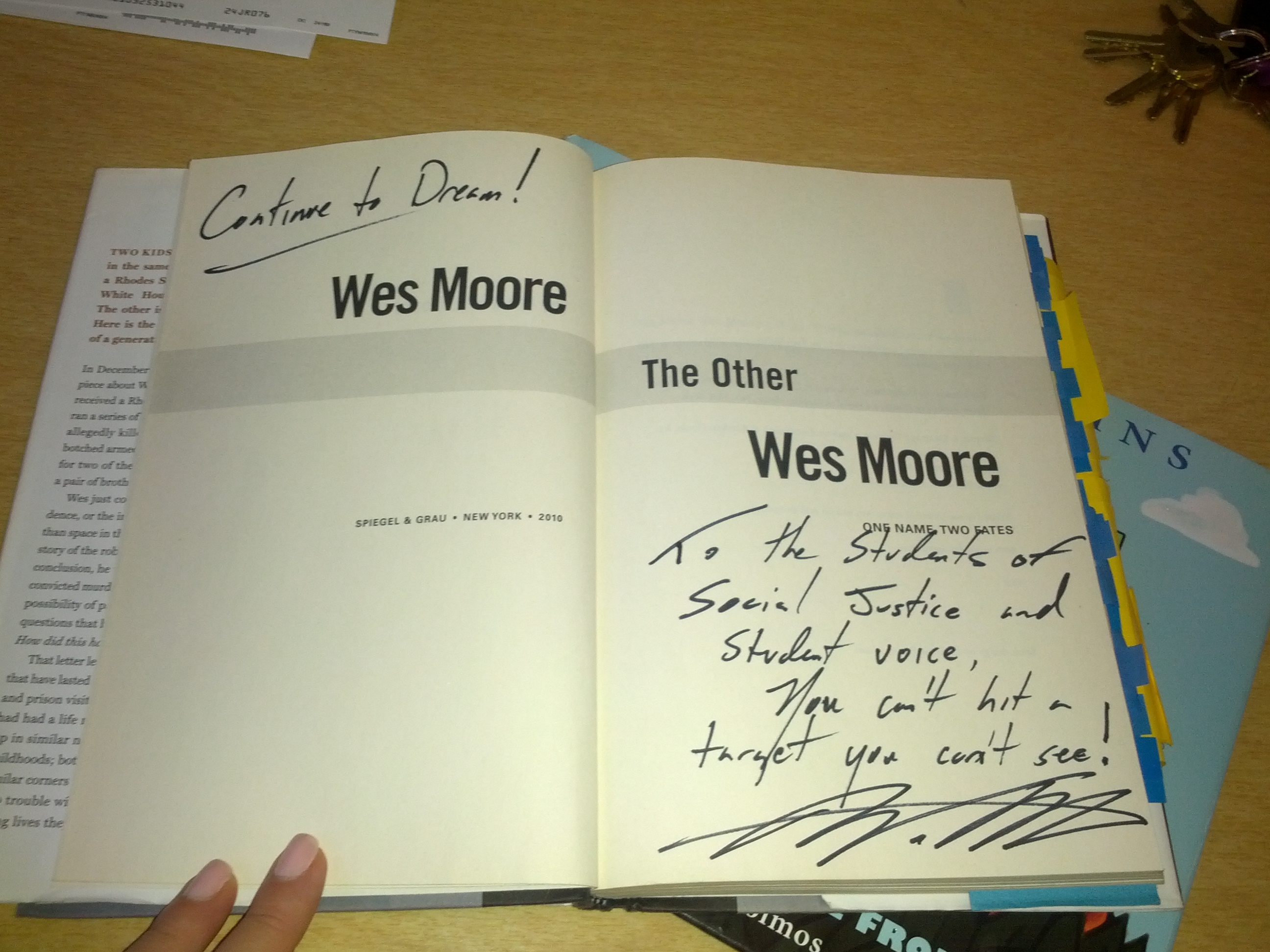
To the students of Social Justice and Student Voice, You can’t hit a target you can’t see. Continue to dream! -Wes Moore

I also love when I get to meet an author and hear him speak about his story; both in the writing and in his account of the events.  What better way to be introduced to another’s extraordinary life?

And, an extraordinary life it is.

In The Other Wes Moore by Wes Moore, upon realizing that Wes was not the only Wes Moore residing (as a youth) on the streets of Baltimore, he felt compelled to connect with the other man sharing extraordinary similarities; the same name, fatherlessness, and navigation through the world the best way they knew how.

And, so the story begins.

By taking a leap of faith and contacting the other Wes Moore (while jailed for a crime that put him behind bars for a lifetime without parole) Wes opens the door for connection, dialogue, and an unbreakable bond.  Human connection at its core.

I introduce students to the significance of the dividing gray line - the shift from Wes Moore to the Other Wes Moore (and vice versa).

In The Other Wes Moore, I introduce students to the significance of the dividing gray line – the shift from Wes Moore to the Other Wes Moore (and vice versa).

That’s all I share with students when introducing them to this piece.  And then the questions swirl: Wait!  What do you mean they have the same name but live such different lives?  Does the other Wes answer Wes’s request to communicate?  Wes visits the other Wes in jail, huh?  What does he mean when he says (compliments of the cover), “The chilling truth is that his story could have been mine.  The tragedy is that my story could have been his.”?  If he’s not in jail, how could it be a tragedy for the other Wes Moore to live Wes’s life?   This is wild!

And now, Discovering Wes Moore (the Young Adult adaptation) provides access to readers who are intrigued by (as the title suggests) discovering Wes Moore, the author.  This piece brings readers through the linear journey of the author’s life, struggles, ah-has, life choices, and incredible realizations.

Both Wes Moores on display in room 382

Both Wes Moores on display in room 382

Here’s what I love about this piece, students do not enter into the potential complexity of following two stories interwoven; they simply get to focus on one story line.  For readers who are interested in autobiographical narratives, this provides them access to a story not to be missed.

Some students enjoy reading both pieces simultaneously by the means of an author study; while others enjoy choosing only one piece to explore.  Students of all reading levels and interests find themselves consumed by these pieces – the craft, reality, and unbelievable story that is oh-so-honest.

The Other Wes Moore and Discovering Wes Moore are continually transient. They don’t stay on our shelves for any extended period of time. As soon as students realize they’re back and available for the taking, they do just that while others’ Next-To-Read lists grow.

I love that both Wes Moores find themselves in the hands of inquisitive learners because, to date, not one student reader has been untouched by their story.

I Am Malala…Too!

From the moment I learned of Malala Yousafzai, she captured my heart.  Two short years ago, this young woman was targeted by the Taliban in Pakistan for her activism in support of accessible education for females.  She went to great lengths to ensure she, and her female classmates, were granted the right to their education.  And that was all before her life changed drastically on that fateful day when the Taliban tried to silence her through unthinkable violence.

Yet, she lives to tell about it.

Not only does she live to tell about it; she writes about it, campaigns about it, continues to fight for it.  So, it is no wonder that just yesterday, Malala was granted the honor of a shared Nobel Peace Prize for her unshakable efforts, astounding heroism, and courageous bravery.

Here’s what I love even more:

IMG_20140908_143856

There are two versions of her story!

In the more complex version (right) aside from learning the intricacies of Malala’s extraordinary life, it chronicles the inner workings of Pakistan, its politics, its back story, and so much more.  It vividly weaves us through the timeline of events taking place in a country that Malala (til this day) calls home.  We visit her classroom, accompany her while doing chores at home, meet her family, join her while eating the foods of the land, watch fearfully as the Taliban circles the streets…This is the piece I read.  Students willing to take on a piece sprinkled with higher level vocabulary and concepts, also enjoy it thoroughly.

And in exposing students to Malala and her cause, we visit her on Facebook at: MalalaFund, on Twitter at @Malala, and on the internet at http://www.malala.org.  We also support the “I Stand with Malala” initiative by sharing our love for literature with the world!

IMG_20130418_155448

So, when Patricia McCormick decided to pair up with Malala to create a YA version of her story, I (and students) could not have been more thrilled.  This piece (left) is written in a more linear fashion.  While it would be remiss to alleviate all of Pakistan’s intricacies, it focuses more on Malala and her journey.  It is a narrative that provides students an opportunity to learn about this incredible young woman, be motivated by her desire to push agendas in the most positive of ways, and gently guides them through an understanding of what life is like for those fighting for their basic right to education.  This piece pairs beautifully with students who have a thirst for knowledge yet are still diligently building their literacy skills.

And so I recommend Malala finds her way (in both forms) into each one of our classrooms.  Let her spark a fire within our students.  Let her show us the way to having the world hear our voices.  Let her age be only a number.  As Malala so eloquently states at the end of the Prologue:  Who is Malala?  I am Malala and this is my story.

And, what a story it is.


All it Takes is a Tutu and Some Focus

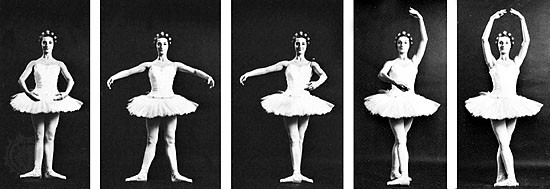
iballep002p1

It’s been a month since I realized that my 2014-2015 school year was going to throw me for loops, spins, twists and twirls.  And while I am by no means a self-proclaimed ballerina; I’m smiling, pointing my toes, and pirouetting with the best of ’em.  Because when the music starts the core needs to be strong, the back straight, muscles tight, and breath steady.

As I stretch daily, as all practicing and proficient ballerinas do, I prepare to move in ways that are brand new; ways in which I never thought my body knew how to.  Legs outstretched, arms over extended, and of course…hair tightly wrapped in a bun – not one hair out of place.  Grace and elegance: the aspiration of all ballerinas.

Ballerinas and educators.

And while ballerinas make their every move seem effortless, the reality is that every motion is executed with deep thought and delivered with exact precision.  The bar is set wildly high and only the best of the best can gently thrust their leg onto that bar as fingertips reach for and surpass beautifully pointed toes while bodies align with a diagonally extended leg.

But, what about the ballerinas who approach the bar with a “Hrmph!” and a stubborn knee that won’t align with the rest of the leg and an unmaintained balance as a ‘steady’ foot is anything but?  And that sleek bun?  That bun has come undone and wisps of hair are continually getting caught on eye lashes and tickling cheekbones refusing to cooperate.  And no, you cannot move your hands from First Position for a moment’s reprieve.

Focus.

When we continue to throw on our tutus and ballet slippers and head straight into the studio before the sun has risen from its slumber: We are not giving up.  We are wrapping our bruised and bleeding toes accompanied by “Ouch!” and “Arghh!” but, we are not giving up.  We are placing even more bobby pins in our hair in hopes that today will be the day we are not tempted to twitch out of First Position.  Today, we stretch just a wee bit further in reaching for our little nubby toes.

As we wiggle and wobble…biting our lower lip oblivious to this false stability…we realize that our calloused hands are resting on those little nubs we’ve so desperately been trying to reach for weeks.  Yes, we are now touching our toes.  Wait.  What?  We did it?

I want to show you something.

Amazing isn’t it?  A young man in my Social Justice and Student Voice course was not willing to explore his 35-60 word biography (modeled after Visa Go World commercials) as it applied to his life.  But, he was willing to explore a puzzling injustice that he firmly believes has a feasible solution.  And his questions.  I could most definitely learn how to shape Essential Questions by conversing with this young man.

I’m still aiming for balance.

My knees are still a little bent.  My tutu is sometimes on backwards.  But, there’s hope!  While the majority of students were actively engaged in chronicling a moment in their lives, one student decided he needed to do things his way: focused, dedicated, and with a little pizzazz.  Is that not what the art of ballet truly encompasses?

As I continue to learn the intricacies of this art form, I take pleasure in exposing students to it as well.  We dance together…sometimes in beautiful unison and well, let’s face it, other times as if we’re all petit sauting to a different tune.  That day, this tenacious student decided to wear sneakers to ballet practice.  And, I’m so glad he did.


Chaos

The beginning of each school year is always chaotic.  Sometimes it’s the overwhelming chaos that can feel debilitating.  Other times it’s that quiet chaos that only you know ensues.  At times it creeps up on us in silence, yet we know it’s found its way into our spiraling minds.  But always, it lives within our being because, quite simply, we are so wildly passionate about upping the ante with each and every group of students that crosses our threshold.  This year, I welcome the chaos.

I have complete and utter belief that the Reading Writing Workshop (RWW) is exactly what my students need.  Better yet, I know in my soul, that it’s exactly what they deserve for their lives; both inside and outside of room 382.

Both inside and outside room 382 students are starting their journeys through the RWW.

Students are starting to journey through the RWW: Inside and outside of room 382.

We have a promising year ahead full with mentor texts, writer’s craft, brilliant student generated ideas, ‘aha’ moments, and all of the unknown that we are willingly going to dive into – together.  But, I would be remiss if I pretended that chaos and uncertainty were not eagerly awaiting our arrival.

Between rolling out the RWW in its entirety last year, more summer classes at the lovely campus of UNH’s Literacy Institute, and a month in the Bronx writing with the NYC National Writing Project; I have been planning.  Incessantly.  Yet, I very quickly realized that all of my planning may be better utilized at some other time, in some far off distance, or at the very least, later in the year.

My plans are fantastic.  I feel it in my gut.

Yet I know they will be utilized and enjoyed when the time is…right.

You see, the beauty within the RWW is that the authentic and natural flow is magical.  Straight up, hands down – magic.  The luxurious task of choosing which piece of literature to start with when oh-so-many are enticing.  The creation of one’s Writer’s Notebook.  The roller coaster writing that sheds light on our own movement and development as writers.  The organic inquiry that surfaces.  All of it.  Every piece is essential.

So you can imagine that after rounding day three of educating, fully engulfed by a feeling of unease, I knew that all of my planning was by no means an effort to be mourned but most definitely an effort that needed reshaping.  As to not let the chaos (starting its crawl toward my vulnerability) completely immobilize me, I made a decision right then and there.  I was by no means going to shift my expectations.  Instead, I had decided to rework all ideas I had about what my students would find engaging.  Because the reality is, my new students are not the same students as last year.

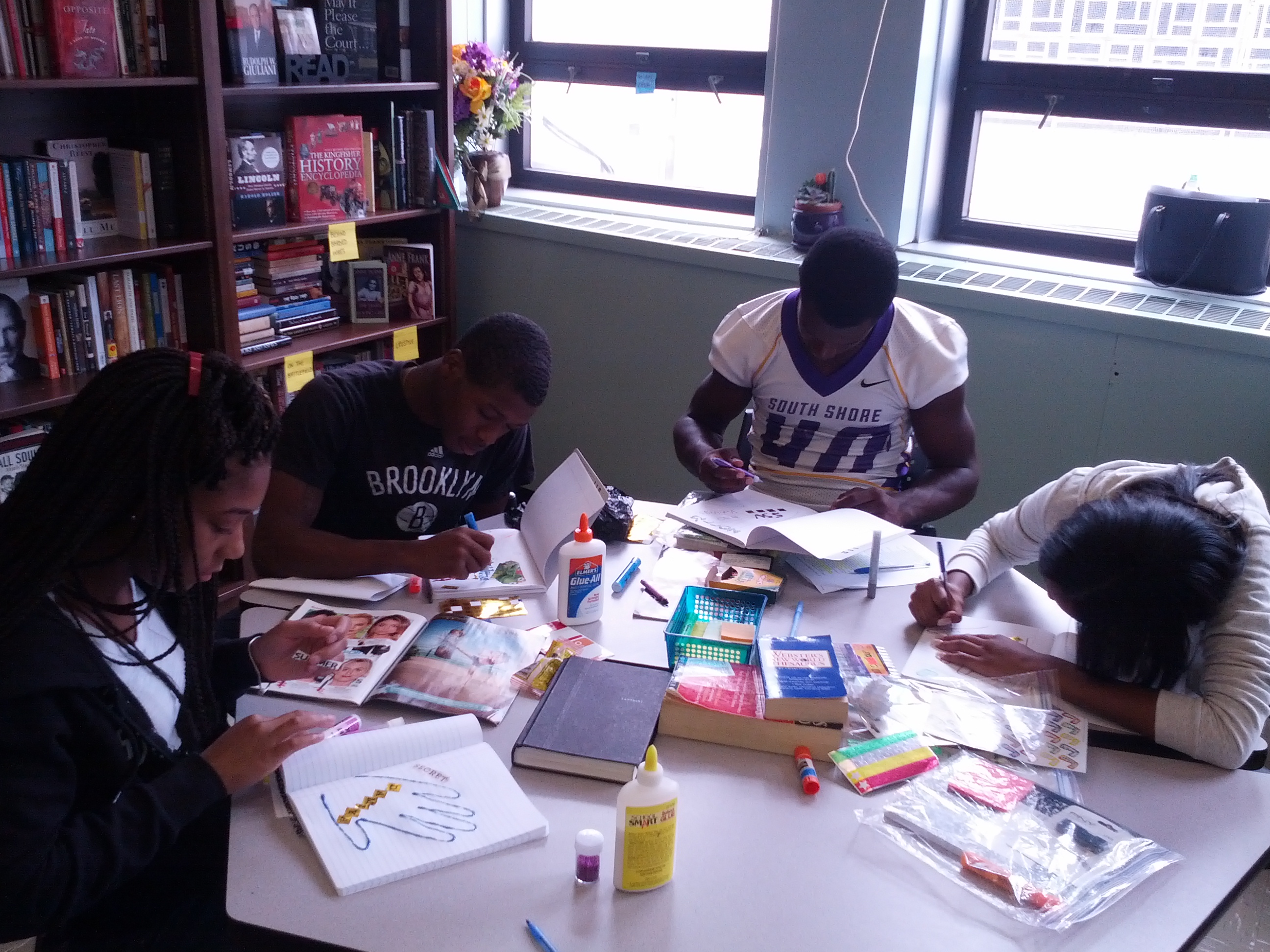
Students creating their Writer's Notebooks in ways that feel most authentic.

Students creating their Writer’s Notebooks in ways that feel most authentic.

Mystery books have flown off the shelves – for the first time ever!  Color is most often preferred when expressing themselves vs. the written word.  There is an untapped intellectual power among every young adult occupying each individual seat that is awaiting its own explosion.  Their passions have yet to be discovered within the context of our learning community.  And, not unlike years worth of previous students, they are incredibly focused and hardworking.

When students are not meshing with the material; when the sparkle does not twinkle in the corner of their eyes as they try to explore new found interests; or they have absolutely no questions…something’s wrong.  Very, very wrong.

I am responsible for guiding students through the beauty of the RWW to foster their own strength, perseverance, and dedication toward the development and growth that is inevitable to happen.  I feel the promise and hope.  I am no longer vulnerable nor am I even remotely entertaining the potentially consuming chaos.  Instead I am enjoying the exploration of new mentor texts while listening intently to the views and beliefs of my wildly intelligent learners.

Here’s to an invigorating year full of unforeseeable experiences, ideas reworked, and chaos debunked.


Mentor Texts Are Everywhere!

This time last year I was amidst a mad dash – a mad dash in seeking out, organizing, asking about, researching, contemplating, and gathering the ‘best of the best’ of mentor texts.  I had just learned what a mentor text was (text that, well, mentors!) and wanted to make sure I had a plethora to kick off the school year.  And, I did.  I had gathered so many I wasn’t even sure when, and in what context, I would be using them.  But, they were ready and I felt confident that I was too.

This year, it’s a bit of a different story.  After implementing the Reading Writing Workshop model in my urban oasis for the first time this past school year, I realized there is no longer a need to be dashing about.  Mentor texts are everywhere!  Literally.  They are in the morning’s newspaper.  They reside in the autobiographies I always find myself engaging in (and of course, loving).  Articles promulgating the Twitter circuit for the purposes of dissecting content and craft.  Classics, more modern, and everything in between became focal points of inquiry and investigation.  Students’ independent reading books shed light on crafty moves authors strategically choose to utilize.  On occasion, an excerpt from professional development texts deserved a public viewing (sometimes with scrutiny, sometimes not).  Nothing is off limits.

So, it is no wonder that as I have been reading a vast array of literature this summer; I have new mentor texts lined up for this coming school year that I am thrilled to explore with my students.  So, grab your Writer’s Notebook and flip to your Next-To-Read list.   I hope you not only fall in love with these pieces, just as I have, but they inspire you to think about what you’re reading and how you’d like to share them with the brilliant and inquisitive minds occupying your learning community.

Making Meaning with Texts: Selected Essays by Louise Rosenblatt was first introduced to me in this summer’s UNH Literacy Institute via Penny Kittle’s Book Love course.  This piece sent a buzz all throughout the campus as we were asked to read it for homework and come prepared to discuss it the next day.  Before the night was through, classmates were chronicling their amazement and joy with Twitter posts such as:  “Reading Louise Rosenblatt for homework and keep saying “Amen, sistah!” in my head. #unhlit14″.  So, you can only imagine how this Reading Theorist evoked an awakening in us all.

IMG_20140630_221534

It was when I came to this paragraph that I realized I had just stumbled upon an incredible mentor text; not only for myself as an educator, but for students as well.  What better way to expose students to the questioning and thinking behind our reading and writing than by sharing the source with them?  These questions are going to guide us through our reading (and writing) journeys this year.  We are going to study these questions, make sense of them, put them into practice; but, we are also going to really delve into why Rosenblatt has chosen these questions to guide us.  See, that’s where exploring craft and an author’s intention becomes our focal point.
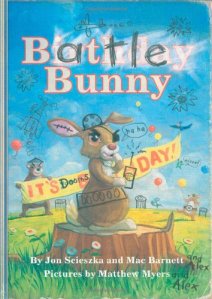


battle 1

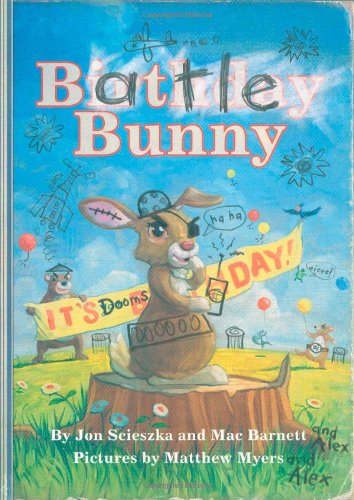
Battle Bunny by Jon Scieszka and Mae Barnett is a clever and witty piece that is sure to get students charged up about editing and revising.  How could it not?  This entire piece chronicles the the narrator’s (yes, the bunny) stylistic and creative writing journey.  The entire story is marked up, crossed out, reworded, and illustrated to show the power of the writing process.  It’s beautiful.

While I educate students ages 16-21, and this piece (I’m sure) was not intended for that audience, I believe this mentor text will be a lighthearted way to quell some of the fears that override their writers’ anxiety.  We know, many students are uncomfortable and afraid to revise, rework, or allow their time-intensive writing pieces to become ‘messy’.  Yet, that’s what produces the most profound writing.

battleI know this may be a risky move in my classroom.  Yet, I’m going to take a chance.  I anticipate shared laughter as we navigate this piece together.  I also plan to explore the bunny’s intentions and make it relevant for our work as writers:  Why did he feel the need to rewrite the story?  Do the illustrations add to the message he is portraying?  Do any of his original thoughts (verse his revisions) feel more powerful to you?  What intentional moves did he make in re-creating this story?  And on and on.

IMG_20140812_121342

Destined to Witness: Growing up Black in Nazi Germany by Hans J. Massaquoi is a piece I have not been without this entire summer.  And, although I’m finished reading it, I find myself flipping through the pictures over and over; it’s that profound. Massaquoi is a mentor of life, overcoming adversity, obtaining the (perceived) impossible, and what it truly means to be human.

Journalist by trade, Massaquoi takes such grace in his every word, sentence, and strategic ‘move’ that’s crafted.  This book encapsulates 443 pages of sheer brilliance and I want students to be exposed to this kind of writing because they too, have the ability to craft such beauty.

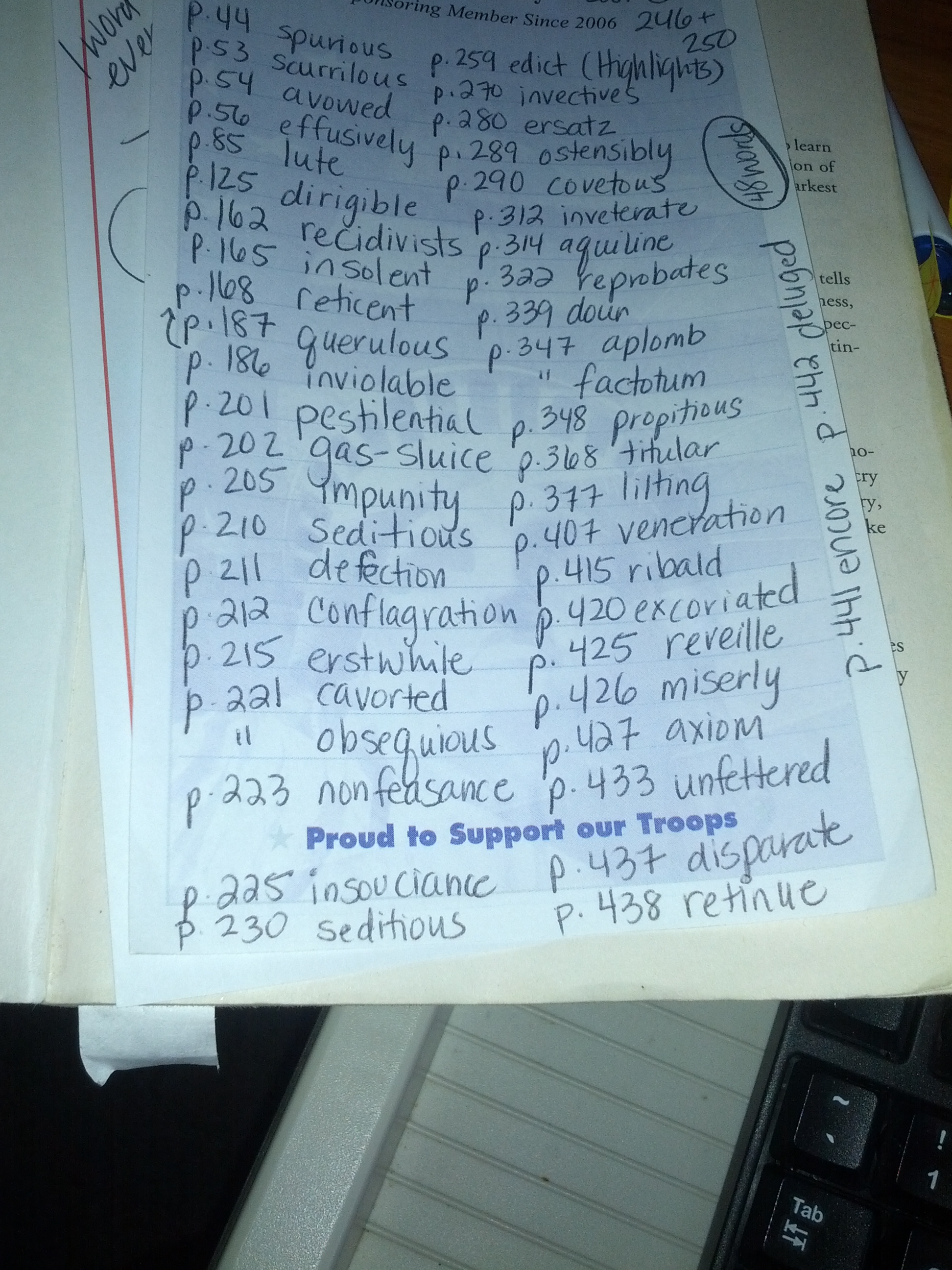
I also want them to catch a glimpse into my journey while reading this piece (note post-its) because I want to share what I found fascinating.  I want to explore some of the word choices (see my unknown word list) IMG_20140812_121513and talk strategy.  I want to use some of these words within my own vernacular and challenge students to do the same.  Most importantly, I want to show them that reading is a process; not one to shy away from.  And yes, sometimes it takes work, but overtime it becomes natural…and wildly fulfilling.
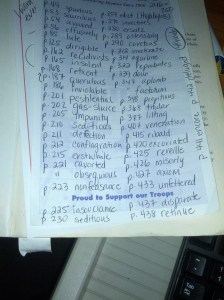
I can’t help but think, above and beyond the work I plan to do with this text, that the historical context won’t propel students in their study of history as well.  World War II and the Holocaust have rarely been depicted from the racial standpoint in which Massaquoi portrays.  This just may be a piece that peaks enough intrigue among students that they too will add it to their Next-To-Read list.  That’s my goal.
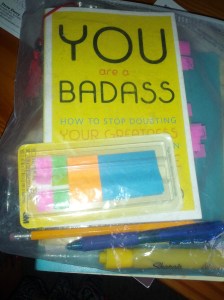


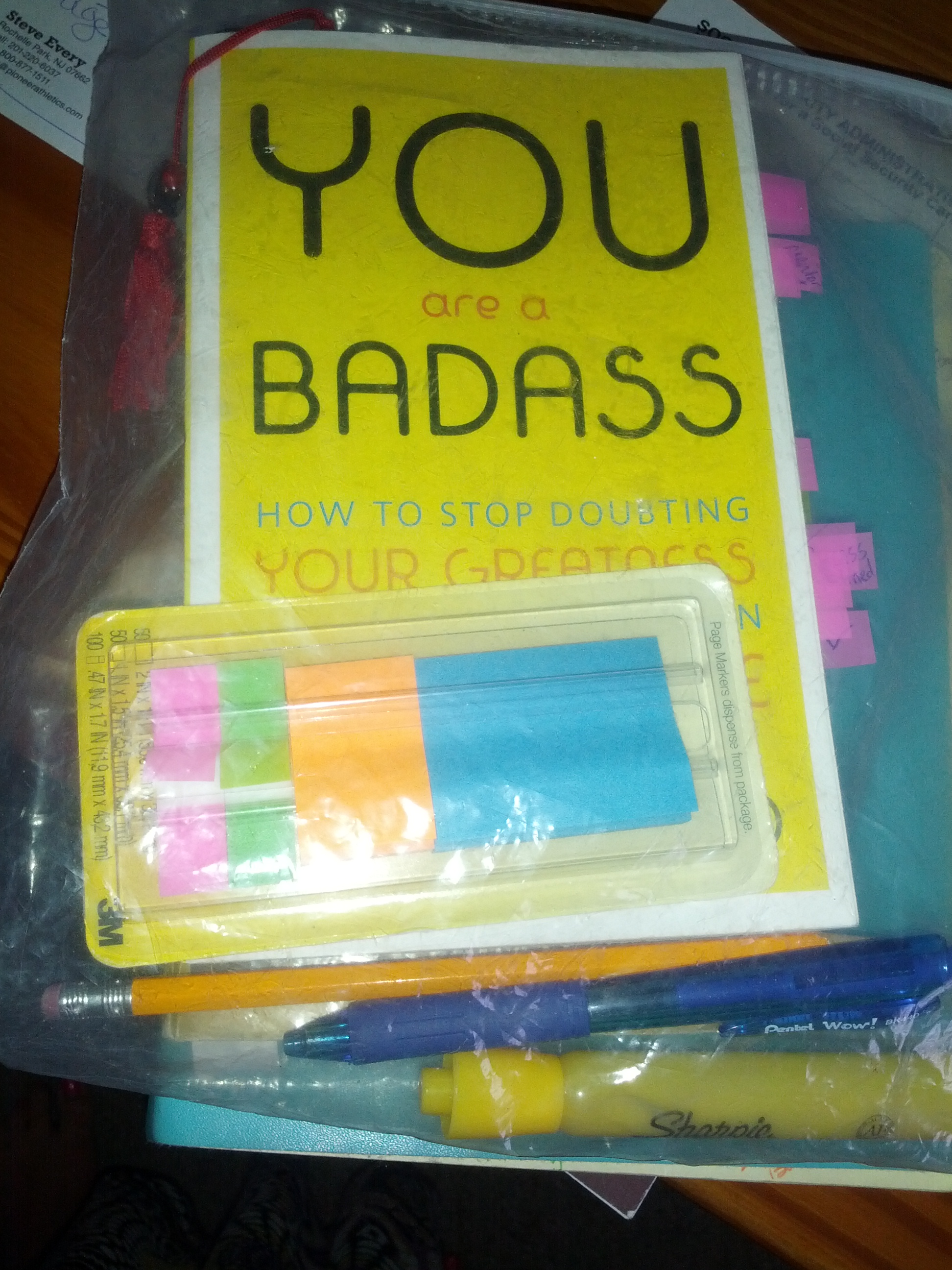
IMG_20140812_124058You are a Baddass: How to Stop Doubting Your Greatness and Start Living an Awesome Life by Jen Sincero has found its way into my Survival Book Kit and I love it!  I’m just past the first thirty pages, yet I have not stopped laughing.  Yes, out loud.

Sincero most definitely has a way with words.  She is edgy and a straight shooter for sure.  Yet, she is able to talk about really serious life-changing ideas in a way that feels ‘light’.  Not your typical self-improvement piece.

I want students to see how infusing humor among the serious can be oh-so-powerful.  Utilizing analogies to talk about the conscious and subconscious mind provides readers visuals…imagery.  A way to process this vitally important information that can shape their lives.  In only the most positive of ways.

I plan to choose the excerpts from this text skillfully.  I want students to have access to the content and the craft…as always.  I do foresee really rich one-on-one reading conferences with those that decide it’s time to make a change in their lives, or at the very least are up for a great laugh, and decide to take this piece on independently.

I hope my four have inspired you.  I really do.  I hope it will do the same for my students.  I encourage you to also share your favorites, here on this site.  As we all gear up for an incredible year to come, and we are swiftly shifting into our ‘going back to school’ mode, this is a wonderful time to start thinking about what we’re reading in a way that lends itself to the idea of being a mentor text.  Articles, books, poetry, graphic novels…all are welcome.


My Life Is My Message

ocs

Mahatma Gandhi once said, “My life…”  

Nope.  Run-of-the-mill.  Try again.

“My life is my message” is a phrase many hear…

Oh absolutely not!

The pacifist we have come to know as Mahatma Gandhi has eloquently proclaimed, “My life is my message.”

Hmm…getting there…


Welcome to the most recent Writing Workshop’s task taking shape in room 382.  As we gear up to wind down as the end of the year approaches, we have taken hold of a striking quote and are playing with it with fervor and inquiry.  Students know, in under a month’s time, they will inevitably be greeted by the New York State ELA Regents.  Yet, we’re operating as though it’s not about to happen; you know…it’s going to happen to everyone else, and of course we wish them all well, but us testing?  Nope.  Not going to happen.

We are exempt.

We are not preparing for an exam.  We are not losing sleep over this literary element or that grammatical rule.  We are not counting the supposed seven sentences assigned to every paragraph or where to locate the anxiety-ridden answer to #23. We don’t care if our pencils aren’t sharpened to perfection or how 33.7 seconds should be allotted for each multiple choice question.

Instead.  We are writing.

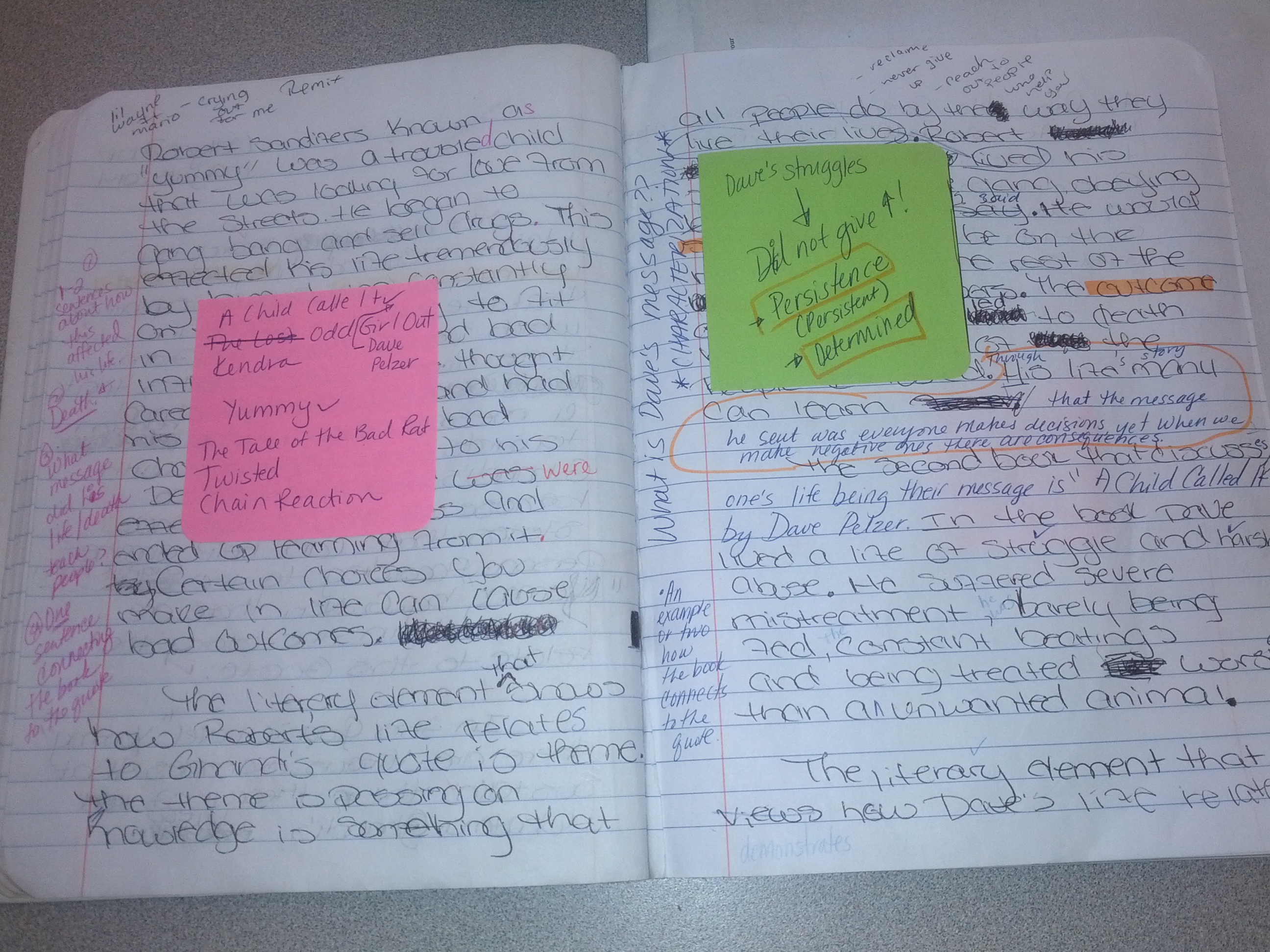
We are researching, connecting, analyzing, and sharing our insights.  We are using Gandhi’s autobiography and other written works that were created solely for us; for us to explore Gandhi’s magnificent brilliance.  We are using other pieces of literature that connect to this sentiment that yes, “My life is my message”.  We are using literature that we’ve highlighted and annotated (to the point where the next reader is going to have to try to find space on these pages to do the same – good luck!).

A student said this looks like a 'piano of ideas'.  I couldn't agree more.

A student said this looks like piano keys full with ideas. A tune we enjoy playing.

We are not allowing ourselves to get caught up in the ardency of the testing hoopla.  Instead we are reworking introductions, continuing to fill our door of completed literature, laughing a lot about students renaming book titles we’re enjoying (gone is The Freedom Writer’s Diary, to stay is The Freedom Writer’s Craft)…  I am sure, at this point, those who have fully emerged in test prep have started biting their nails, twisting and tugging at their hair, and maybe even pacing as they continue to read this piece through the slant of a squinted eye.  I understand.

I do.  Really.

It wasn’t until this year that I shifted a vast majority of everything I do in my classroom…with my students…in my own head as I reflect.  I was the educator who believed in preparing students, even if it meant solely for an exam because it’s always been rooted in support and wanting students to be successful.  I am still that educator that believes students deserve success on exams.  Yet, this year I want them feeling success on their exams because they feel creative freedom while still being locked into the three-hour time constraint.  I want them to smirk while exploring their craft as they connect literary elements to the exam’s text; and not feel as though they need to lose a sense of who they have become as beautiful readers and writers.  Mostly, I want them feeling confident that this year’s dedication to enhanced reading and writing is shaping how they look at the world; exam days not exempt.

Naturally, students’ anxiety about testing still surfaces, but this year, it remains there – on the surface.  Students still have test specific questions, ones I acknowledge briefly and then move on…(deciding between four topic sentences is way more fun!)  We still game plan so students know what sections they are going to attempt first…or last.  We talk timing.  We do all of that.  We just don’t let it consume us.

And because we don’t, I have thrown away all structured writing graphic organizers that I used to believe supported students in elevated writing.  Students are approaching their writing in ways that provide us all moments of pulchritudinous pause.

Every inch utilized with ideas..thoughts...movement.

Every inch utilized with ideas..thoughts…movement.

Students use varying angles in which to deliver a quote’s message and are demonstrating alternate ways on how to enter into that analysis with a fresh perspective.  It is through this exploration that students have challenged me to educate with new insight.  Our commitment to the process; pushing ourselves beyond boundaries; and most importantly, our collective energy still provides each new day with an exhilirating thrill.

From our classroom to yours, we wish everyone the best as the end of the year exams approach.  We wish you continued laughter, reading, and much writing.  And don’t forget to have a tremendous amount of fun along the way.  We are.

What ways are you fostering the joy of reading and writing with your students during this stress-inducing time of year?


What’d You Say?

ocsAs the year is rolling (rapidly) to an end, I have taken time to reflect and really analyze how this year’s movement and progress has been different then years past.   Besides following the footsteps of the amazing Penny Kittle; borrowing sky writing from the vivacious Shana Karnes; bouncing ideas off of the astounding Amy Rasmussen; and being inspired by the wall-to-wall library of the ever-evolving Emily Kim…I realized that this year, I am talking differently.

In posts pasts, I’ve mentioned a full on effort of instilling calm in my teaching, but most importantly within myself.  I’ve talked about strategies and tactics to support our lovely readers and writers.  I’ve discussed the power of revision.   I’ve done a lot of talking.  Yet, I haven’t reflected as much on how I’m talking.  And, just the other day, as I was standing in the middle of my classroom admiring the soft buzz surrounding me, I realized what was happening.   Students no longer depend on me.  They are depending on themselves and their peers.  They are listening intently, supporting one another, and using language that I (at that moment) realized reflected what I’ve been saying all year.
I’ve always made a conscious effort to refer to the individuals I educate as students or young adults; both in speaking with them and with others about them.  Kids?  Children?  Never.  To me it’s important to afford them that respect.  Yes, they are and always will be their parents’ and guardians’ children, but to me, they are the evolving, growing, and inspiring young adults who show up (as often as they can) serious about their education.

Interestingly, this year one student decided that he is no longer a student, but a scholar.  Well, aren’t I the lucky educator exploring and learning among scholars?  Yes, this is now the norm.  They are sitting up straighter, not because I am that educator who demands upright students, but more simply because they are feeling important as they use this term to describe one another.  They own their importance.  And how beautiful and distinguished they look doing so.

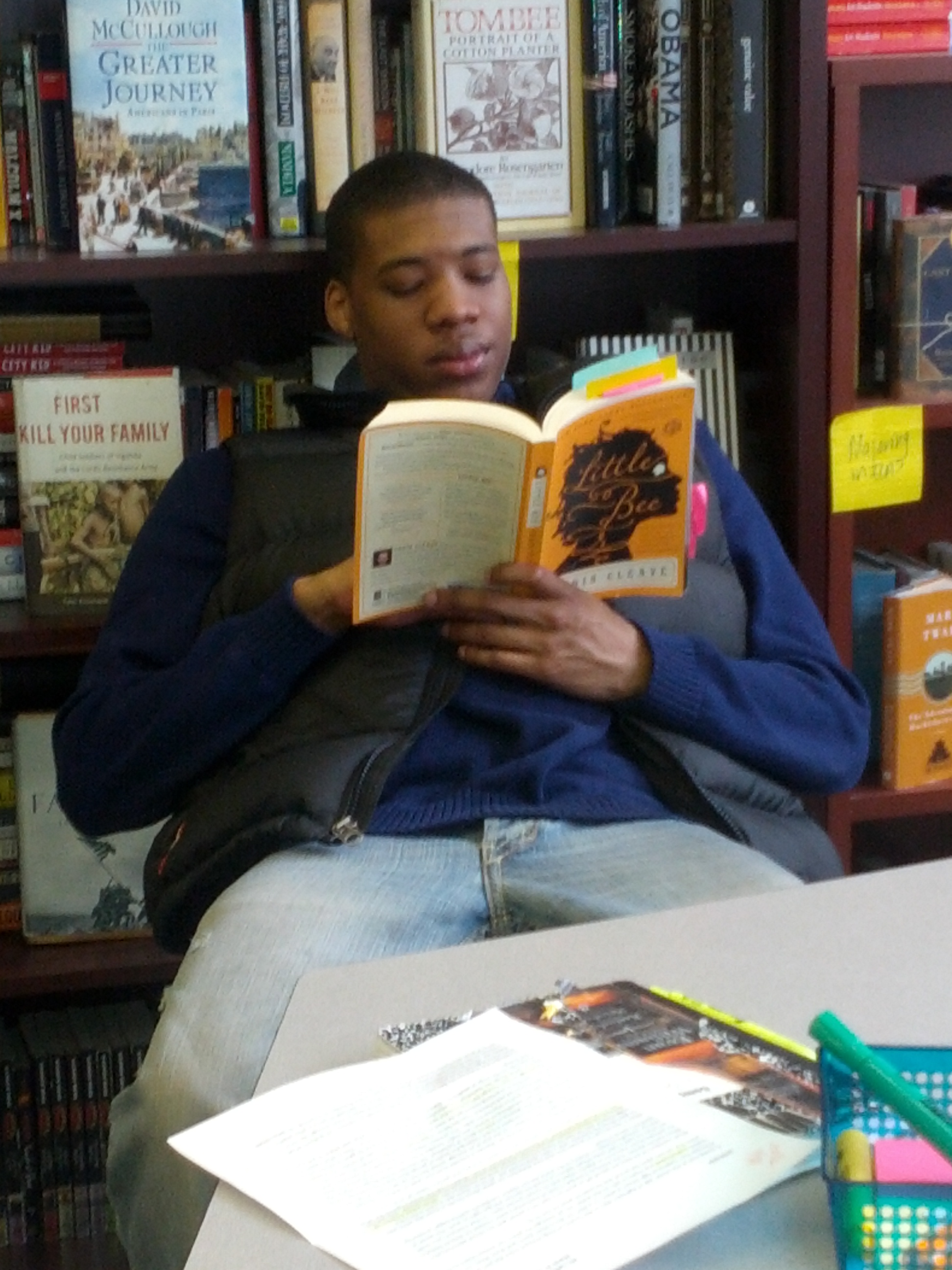
Now that I’m among scholarly greatness, when it comes to literature, “What book are you reading?” has pretty much become extinct in our learning community.  We talk about books as pieces or literature.  It’s amazing how synonyms prompt different levels of affluence.  There’s an air of ownership and pride when students are discussing literature.  Whether it be a review of E.B. White’s Charlotte’s Web, the graphic novel of Anne Frank, Hill Harper’s Letters to an Incarcerated Brother, Chris Cleave’s Little Bee, Alex Haley’s Autobiography of Malcolm X, John Steinback’s Of Mice and Men, Dr. John Gray’s Men are from Mars, Women are from Venus, and so many others…students are examining them with wonder, inquisition, and esteem.

Chris Cleave in the hands of a scholar.

Chris Cleave in the hands of a scholar.

While reading these pieces, we are no longer just looking up words in the dictionary.  We are researching.  We are finding what we need in order to fully understand what is before us.  We are using our resources to enhance that understanding.  We are not only completely comfortable with the extra step of flipping through Webster to explore our options, but we are embracing it because it’s now just part of who we are as learners.  Yes, we are researchers.

Multitasking: writing and research.

Multitasking: Writing and Researching

And, we are not flawless.  We find definitions that don’t always make sense.  So, we find partners who can help us grasp the concept of this idea in the context of our individual reading.  We are active.  We support each other.  Students and I have made a pact; when they do not know a word they take to research.  However, when they do not know how to pronounce that word, I become their resource.  See, there’s a huge difference between the two.  Students are no longer relying on me for a definition, just the initial step of knowing what the word sounds like so they can productively use it on their own, and in context, once they are comfortable with its meaning.


Collaborating on a project.

Collaboration

Above and beyond all of the communal support we provide for each other, there are those times that we are just plain “stuck”.  When students approach me with this, I no longer ask, “Why?”  Instead, I ask, “What is the reason?”  or “Let’s identify what’s happening here.”  Even in those moments when we’re not sure we even know why we are stuck, I’m asking students to own, articulate, and start problem solving their moment of frustration to alleviate the feeling of intensity.  Once I started probing, students realize there’s a reason they are at a standstill.  As we move through the recognition and pinpoint the issue, we are off and running (again).

Hearing students playing with language, context, and dialogue is magical.  A lot has shifted this year.  Students are continually showing me what they need from me to support them in their growth.  Whether it’s asking a scholar what piece of literature he will be embarking on next or setting dictionaries on every group of desks for easy access to research; students are asking me to support them in their launch.  As we continue to progress together, I am looking forward to recognizing what else needs to be said differently because, wow, what a difference a word makes!

What language do you use that propels your students?  What shifts have you made to support higher levels of learning and engagement?  

It’s Moments Like These

Our Compass Shifts 2-1

My hope for all educators is that we never, ever lose a student. And while that is my hope, life has it that sometimes a student’s passing becomes a reality. In 2010, that’s exactly what happened. Francis Gittens departed our school community leaving behind his energy, electric personality, and smile that only those lucky enough to have had the opportunity to know (and work with) him experienced.

A long time colleague and friend asked me, “Erika, how are you going to continue Francis’s legacy?” At the time, I was overcome with grief and emotion and couldn’t possibly consider this very tall task. However, as I started to work with my new over-aged and under-credited student population, their thirst and desire to obtain information in order to quench their ongoing curiosities provided me the answer.

A library.

Not just any old library, but the Francis Gittens Lending Library. A library filled with rich pieces that have impacted other book lovers from all over the country. I’m talking all genres. I’m talking too many books for the amount of shelving we currently had. I’m talking opportunity.

Out went the email chronicling my mission. The recruiting had begun to wrap the two-hundred plus books that continued to be delivered and dropped off at my classroom door. Ms. Vasquez (Francis’s mother) had agreed to be present for the post-holiday surprise. Food had been ordered. Students had no idea how their lives were about to change. Full of emotion; I was ready.

What has happened in the two and a half years since must still be a figment of my imagination. Students are reading feigns who request piece after piece. Students and their families are continually donating to our class library. Not to mention all of the other generous donors who continue to surprise us with their favorites.  Students have created Next-To-Read Lists because they can’t possibly read all the pieces they are intrigued by simultaneously, although many of them are juggling a couple at a time. Educators swing by to see what’s new on the shelves for their own reading enjoyment. And I have become quite the book connoisseur while perusing book store after book store seeking out unique pieces to book talk the very next day.

Just recently, after I reorganized our theme-based library, I sat back and found myself in awe. The growth of the library, now two-thousand plus books, stopped me in my tracks. I realized that as a collective, we have figured out a way to support our (sometimes struggling) readers and found a way for them to have all the access they want (and need) to the world beyond their own. Astounding.

I immediately phoned Ms. Vasquez inclined to show her what’s been taking shape in room 382. To no surprise her response was, “What day works best?” We both felt the urgency. She found her way to Brooklyn Bridge Academy without hesitation that very next Monday. As she entered the room, student conversations quieted and a hush fell over our shared space humbling us all.

As we all regained composure, conversations started to bubble and students were excited to share the literature they are (and have been) reading. Ms. Vasquez took her time scaling the length of the library and, overcome with emotion, she cried.

Ms. Vasquez pointing out an inscription to Francis from his Grammy in Sidney Poitier's Measure of a Man.

Ms. Vasquez pointing out an inscription to Francis from his Grammy in Sidney Poitier’s Measure of a Man.

She took the opportunity to talk to students about their lives and the decisions they are making. As we sometimes say, “She went there.” She focused on the young men, their appearance, and the injustices they are ultimately always going to face. She spoke directly to the females and advised them in believing in themselves, taking care of their bodies, and their intelligence. She focused on the vast literature lining the shelves and how this (education) is their key to the lives they deserve to live.

Tender moment with a male student.

A tender moment with a male student.

As educators, it’s these ‘full circle’ moments that make us truly feel full with love, hope, motivation, and connection. Students are reading more now than ever before.

Our read literature this year.  180 plus books!  Beautiful collection from the FGLL.

Our read literature this year. 180 plus books! Beautiful collection from the FGLL.

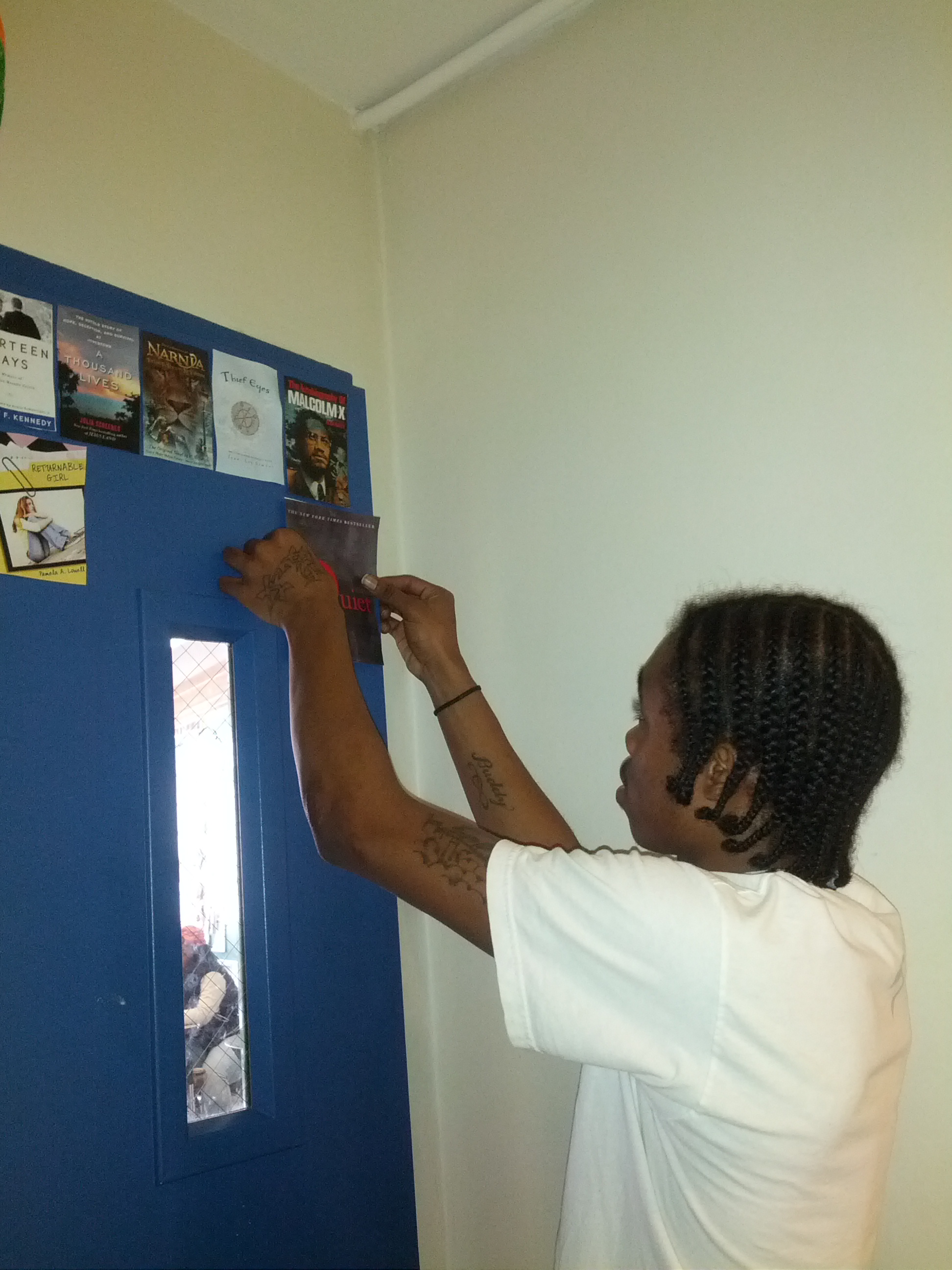
A proud student adding Quiet by Susan Cain to the other side of the door.

A proud student adding Quiet by Susan Cain to the other side of the door.

They are embracing their inquiries and willing to do the work to find answers. They are supporting me in my own reading journey and I them. We are collectively always looking for pieces of literature to add to our library and relishing in the ones that we can’t believe we actually found.

Each donated book receives a FGLL Placard (Donors, location, date)

Each donated book receives a FGLL Placard (Donors, location, date)

We have shared humorous moments. Tears have been shed. In-depth thinking has…and continues to take place.

From an incredibly tragic loss to a beauty hard to put into words, we are all so very thankful. But most of all, humanity came together for those sixty minutes on a random day in March that none of us will ever forget. We are in this together, as a whole, as one.

Our 'serious' class photo.  (My favorite!)

Our ‘serious’ class photo. (My favorite!)

How will you continue to build and support literacy initiatives in your classroom?

Tu Eres Mi Otro Yo

ocs While recently in the throws of February break rejuvenating away from the hubbub of the city in the quaint beach town of Montauk; Malcolm X and I were becoming intimate acquaintances.  We had been for quite some time, actually.  But it was here that I really started questioning him, his motives, and his overall sense of dedication to any cause he finds justified.  As I was making direct connections to my own beliefs and passions, my pen went haywire.  There was, by no means, enough blank space on the pages of this autobiography for my own thinking.  Out came the post-its.  The power button on the iPad came alive and my inquisition and deep thought went ablaze.  While X and I could not be more different human beings the ideal of commonality among passion elated me.

Later that very same day, I was introduced to Dr. Jeff Duncan-Andrade’s invigorating message that immediately added even more fuel to my already-burning fire.  From the moment I pressed play (thank you, Apple TV) I was captivated.  Jeff is an outstanding educator who believes there are three kinds of hope: material, critical and audacious.  He believes that our [urban] students are roses growing in concrete.  I mean, the city has always been referred to as the concrete jungle!  In order to really grasp the intensity and genuine love Jeff exudes with his message, you’ll have to watch for yourself.

There I was, hours away from the city and my students, yet never have I felt so connected.  X’s passion exudes from his autobiography; Jeff’s passion seeps through his pores as his care is so loudly presented; and my passion was turning up the waves in the ocean right outside my window.

On my drive back to work that first Monday morning after break, I made a promise to myself.  I promised to stay true to my passion and invite the new found passions I discovered to reside within me as well.  My focus was by no means on the road, it was zoomed in on Jeff’s mantra: Tu eres mi otro yo! (You are the other me!)  How could it not be?  How could I not be heading back to room 382 thinking, “Students, you are my reflection…you are what I see when I look in the mirror.  We are one.”?

As I headed into our building, my mind automatically trained itself on a female student that I have been working with for six months, but have yet to authentically connect with.  Today was the day that was going to happen.  The day had not begun, but I was sure of it.  I was sure of it because I was going to channel all of the passion, intensity, and love I gathered over the break and pour it all over this student.  I only hoped she wouldn’t mind!

As independent reading commenced I asked this student to join me with her new book, highlighter and pen.  It was a piece well below her reading level (as is typical of her reading selections), but the premise captured her attention immediately: females making decisions based on their desperate need for belonging among other female peers.  There’s no wonder.

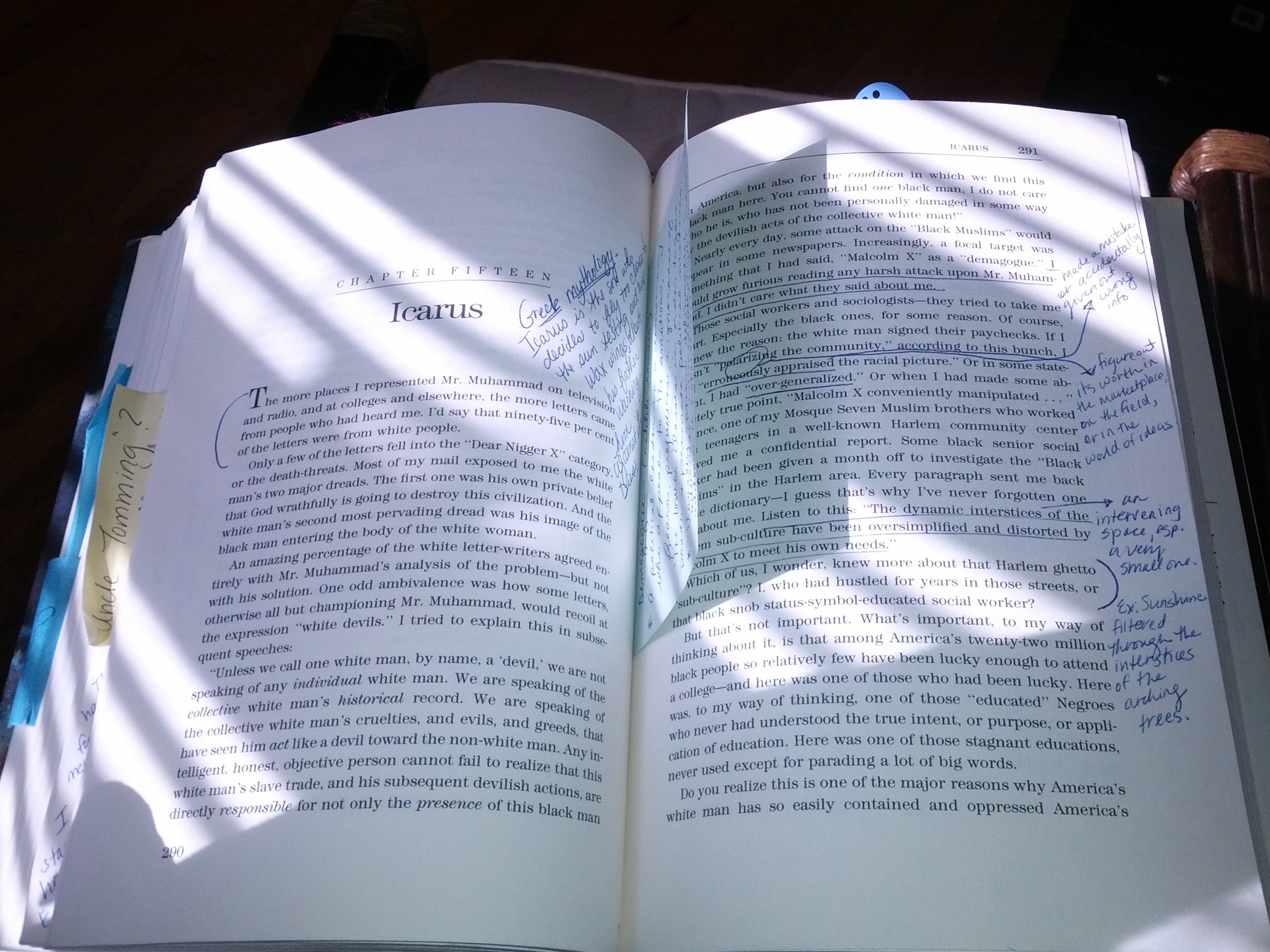
X followed me to class that day, in many regards.  As I put my chosen piece of literature on the table, a ‘huh’ surfaced from this female student.  I opened to the chapter titled Icarus.  IcarusI asked her if she knew what the title meant and the following is the dialogue that surfaced:

B: Nope.

Ms. B.: Neither did I.  I decided I wasn’t going to go any further into this chapter until I understood what this name resembled.

B:  Huh.

Ms. B.: So, I took to the internet and realized Icarus is the name of a Greek mythical figure whose father warned him of not flying too close to the sun with the wax wings in which he created for him.  But, he did.  And he fell straight out of the sky.  Can you imagine?

B: Wow.  Huh.  That’s interesting.

Ms. B.: Isn’t it?  Then, check this out…(I flipped to the last page of the chapter.)  Read this last sentence.  (B does.) Do you see it?

B:  Whoa.  It connects to the title.  It explains what you just did.  (Smile)

And it was at this moment, that the gathered passion, intensity and love I poured all over this student started to work its magic.  Because here’s what happened next:

B: Ms. Bogdany, how do you know what to highlight though?  I never know what to say — I mean annotate.

This may seem like a simple (and potentially expected response) but after working with this student since September, this was the very first time she was confident enough to be vocal with her inquiry.  From there we opened her book (with much fervor) and highlighted a portion that she noted.  I asked her what it meant, and she started to explain it…and, in her book, I wrote down her thoughts.  I then asked her about her own ideas regarding this concept, and (with the longest response to date) she explained her insights about the decisions the main character is making.  So, again…I scribed.  We discussed.  I annotated.  She smiled.

Ms. B.: Do you see it now?

B: Hahah.  I do.  It…it makes you understand more.  Thank you.

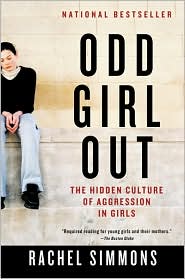
Before she left to resume this process solo, I pointed her in the direction of another female student who had just started reading:                                                                          Odd Girl Out

I explained the premise of this piece.  She raised an eyebrow.  I mentioned that when the other student was done, she may want to engage with it as it’s the same concept that envelopes her piece, yet it’s an informational, non-fiction piece.  This piece is more level appropriate for her.  Same concept, different genre, enhanced level.  We’ll see.

In the meantime, I noticed during the rest of our two hours together that day, B’s book kept finding it’s way back onto her desk; her highlighter was incredibly busy; and her pen was relaying her inner voice on those very pages that previously would have remained untouched.  And instead of refocusing her on the day’s lesson and activity; I whispered internally, “Tu eres mi otro yo.”

haLfwaY tHerE

ocs

The buzzing alarm clock that startles you out of sweet, sweet dreams into the darkness of your frazzled morning is by no means friendly.  (BUZZZZZ…)  Open your eyes.  Quickly!  The abnormally freezing cold of winter; the unimaginable storms that continue to blanket our front lawns and backyard swing sets; the must to have snow boots handy at any given moment accompanied by a shovel and ice brush are in need of your attention – immediately.  The closed-eyed shower.  Fumbling and bumbling around while simultaneously getting dressed, blow drying your hair, making coffee all the while trying your darndest to remain quiet as to not wake other household members is…

Well…quite frankly…getting old; quickly.

The harried morning commute – windshield wipers flailing against the hail and tires shifting in the opposite direction to protect you from skidding– allows you to greet your students (with a smile, but of course!) on yet another cold and unpredictable winter morning.

You made it.

I made it.

We made it.

We have all made it to the half way point of our school year.  Students have pushed themselves in ways we could not have anticipated.  Educators have moved through obstacles with grace and poise.  Administration is pushing harder than ever.  Mother Nature has joined the club.

In the vein of reflection, doesn’t this seem like an integral point to stop…reflect…plan…and dig deep to find our reasons for trailblazing forth?  I think so.  So, here’s what I’ve been doing to keep warm during a brutally chilling winter:

To warm my HEART: I stop planning.  Aside from lesson plans, I have no plan.  I realize that when I stop planning every minute of my day, the most beautiful of moments surface.

From a quick drop in (“Just checking in, Ms. Bogdany.  You good?”) to a first-time-independent-reader so engrossed in Hill Harper’s Letters to an Incarcerated Brother he insists on marking pages to share with me as he passes by during the day.

From a very simple high-five in celebration of a special moment to a poet sky writing his inner most thoughts regarding his hometown.

Sky Writing

See the island of Manhattan, smaller borough
Back on Staten
Cross the county of the kings, then you make your way
to Queens…..

From a post-Regents philosophical discussion about Malcolm X’s beliefs and convictions to a colleague swinging by with, “Your previous Multi-Genre Writing students insisted that Ashlee, whom you didn’t have, show you her creative writing piece because it’s astounding.  They wanted you to see it.  Here it is.”

If my door was closed and my agenda had continued to take control of my day, these beautiful moments that inspire me, would be lost.

To warm my SOUL: I read voraciouslyI live in a sea of literature.  From gathering books from the laundry room’s shared library to the continually growing Francis Gittens Lending Library; I am never sans a book.  Often, I am juggling a few and that includes my new found interest with audio books.  From Room 382 to Apt. 2 (whether themed by topic or color) my soul sings in the presence of literature.

Books Everywhere

New books on display. Students love working among literature…lots and lots of literature.

Rainbow Library

Welcome to my rainbow library. It continues to grow with pieces I’d never imagined would find their home here.
(Feel free to click on the picture to take a peek at the titles.)

And really, what better way to keep warm (during this winter full of icicles) than with a book of choice; pomegranate spice scented candles; and blackberry-vanilla decaf tea?

To warm my MIND: I ask for help when I know I need it.  Yup, pride aside.  Wild, I know.  While I try to be all things for my students, there’s a reality.  And that reality is simple – no one educator can be all things for his/her students.  So, we must find those we trust, branch out, ask for a helping hand and push forward together.  It would be an injustice to not bring them into my ‘teaching loop’ to help motivate and encourage each student they’ve built trust with.  I need them to show me the way.

I also reach out to my PLN, no matter how far, they are always there to help guide, attempt humor, and support in soulful ways.  Their insight and guidance is always a surefire way to refocus my attention to the authenticity of educating.  Of this I could not be more grateful.

So, while we are all bundling up this winter and trying our very best to remain focused in-spite of the blistery weather – which does not seem to be going anywhere, anytime soon – we have much to celebrate.  We’re halfway there!  And instead of looking toward the finish line, let’s all take a moment to enjoy the snow filled scenery and the halfway mark.  It really is a warm place to be.

snow

It’s warm in here! And so beautiful out there!