Category Archives: Angela Faulhaber

What Teachers Really Need To Hear

I have been working on a post about how to teach students to write purposeful conclusions. I’ll still write that. But as I’ve spent the last few weeks working with teachers, creating plans for the weeks before testing, I realized there’s something else I need to say. 

Dear Teachers,

I see you.

I see you on the picket lines, demanding more for students, for yourselves, for our world. I see you in your classroom in the late afternoon light, fine-tuning tomorrow’s lesson. I see you on the last day of spring break, bringing your own son to school, working for hours in your classroom to get ready for the week. At your daughter’s soccer practice, grading papers between goals. At the beach, reading books your kids might like. At the library, scouring shelves for the just-right books about mullets for that one kid.

You. Are. Amazing.

I see you now, as testing season blooms, these weeks that have been looming finally here. I see you cheerleading and boosting and nudging. I see you creating review games, engaging kids and building their confidence. Behind that, though, I see the stress, the wonderings, the worry.

Will they try?

Are they ready?

Did I do enough?

The answers: Probably. Yes! Absolutely!

The truth is, we’ve done everything we can. We are at the doors of the big game, and what’s left is to cheer. And to remember that despite what it feels like, the test is a slice of a year full of wonder and growth and success. 

The tests feels huge — they are huge. But these tests are not the sum of you as a teacher. Just as you remind your students that they are more than a score, you are more than a growth measure or a value added or a designation on an evaluation. You are their teacher. 

I’m reminded too that after testing season passes, we still have several weeks of instruction left this school year. What a gift! We still have time to introduce students to new characters, to immerse them in new genres of writing, to push them to stretch.

Dear Teachers, I see you. You are beautiful and strong. Thank you.

This letter is inspired by the piece What Students Really Need to Hear by Chase Mielke (a great mentor text for students!). 

Angela Faulhaber works as a literacy coach in Cincinnati, OH, and teaches pre-service teachers at Miami University. She is in awe every day of the passion she sees in teachers and loves planning with and supporting them so they can do their best work.


Three Ways of Looking at a YouTube Video

If your kids are anything like the ones in my life, both at home and at school, then they love YouTube. When I ask them what they watch, they list names of YouTubers.

At first, I scoffed at this medium that seems to absorb all their energy. Then I started noticing something.

IDEAS

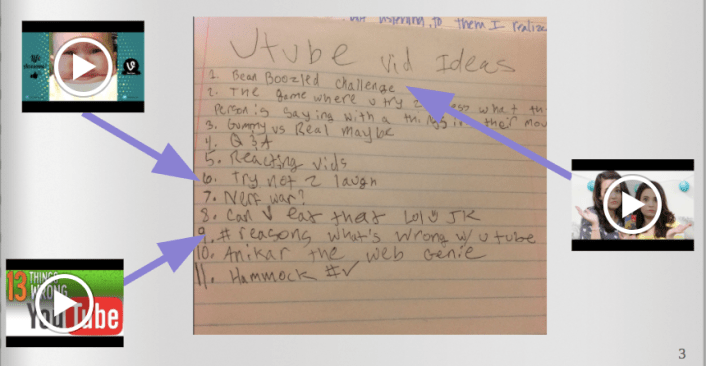
It started last summer after I kicked my three kids outside to play. They were writing in their notebooks furiously. Being my nosy self, I peered over their shoulders.

My kids, who are wonderfully, beautifully average, were planning their upcoming YouTube “projects”. They’d found an old digital camera and had been making videos (but not yet posting them anywhere). Upon further inspection, I noticed that many of these videos ideas were inspired by ones they watched endlessly on YouTube. They were using the texts they love as a way to generate ideas for their own composing. Further, they were using YouTube as a mentor text.
Screen Shot 2018-03-07 at 10.59.29 PM

They reminded me that often when I use mentor texts in my own instruction, I want students to use the mentors to generate their own ideas. Whether we read The Important Book by Margaret Wise Brown, or an essay about Hermione Granger in The New York Times, I want student writers to use those texts as launching pads for their own thinking around topics. I know that one of the most important things that writers do is choose topics that inspire them. I also know that doesn’t happen by accident or chance or magic. We have to teach students how to find their ideas and mentor texts can help us do that.

STRUCTURE

A few months later, my 10-year-old son started his own YouTube channel. One day I walked into his bedroom where I saw his bulletin board covered in notes. He had created a vision board about his channel where he posted a criteria list focused on what Screen Shot 2018-03-07 at 10.58.07 PMhe had been noticing in other videos. Upon further inspection, I noticed he had also created a template for a video. He was making note of the patterns in the videos, his mentor texts. He paying attention to the structure of a video, to the introduction (the intro) as well as the conclusion (the outro). He also made notes about what not to do.
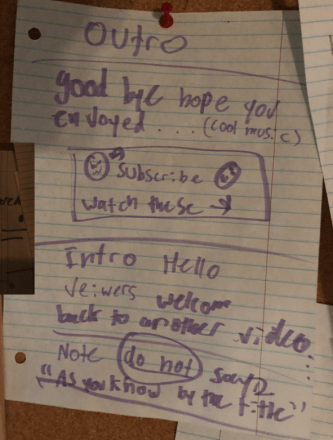
Jacob’s work around structure reminds us that another way of looking at mentor texts is through the eyes of organizational patterns. When we ask students to notice how something is built, we invite them to create possibilities for their own writing. I want my students to read like writers and to make choices about the way they might structure a piece of writing. Mentor texts help us create a vision for doing that and they empower students to uncover those possibilities themselves.

CRAFT

As Jacob’s gotten better at making these videos, I’ve noticed that he’s also gotten better at the craft within the videos. He and his younger brother Justin decided to launch a series together (of which they’ve only made one episode). When I watch just the first minute of the video, I notice the way they use their voices and gestures. I notice the way they set the stage, displaying the title. I notice how they have clearly rehearsed what they’re going to say. These are all things they’ve picked up from watching their favorite videos, from studying the mentor texts. They identified nuances that add voice and flavor to the text, and then they tried it

Their attempts at incorporating these moves reminds me that another way to consider using mentor texts is to think about the ways we can teach students to read like writers. When we teach students to hone in on the craft moves a writer makes and to think about the purpose of the moves, they can start to think on a granular level about their own writing. The next step is to try those moves out in our own writing.

WHAT DOES THIS MEAN FOR OUR TEACHING?

As I notice the way my own kids have become immersed in these texts, I can’t help but think about how this relates to my own teaching using mentor texts. It’s not enough to show students a text and say, “Okay, now do this in your own writing.” We know that doesn’t work. Instead of becoming frustrated that kids don’t “get it,” I want to instead use  mentor texts with intention.

Using mentor texts is also a process. I can’t expect for students to be able to look at a text and consider ideas, structure and craft all at once. I have to carve out time for students to be able to work through the different ways mentor texts can support them as writers. I have to teach with intention so they can write with intention.

When I consider immersing students in the kinds of writing that will help them grow as writers, I want them to have the same kind of authentic experience as my kids did. As a teacher, I also want to lean in to exploring all the ways mentor texts can look in my classroom — anything from YouTube videos to essays to infographics can help nudge writers to think about how to generate ideas, how to make choices about structure and how to develop their craft.

If you’d like to learn more about finding mentor texts, you can check out this smart Mentor Texts Are Everywhere.


Creating Conversations That Move

In my work as a literacy coach, I have the privilege of working with teachers as they implement elements of reading and writing workshop into their classrooms. Right now I’m working with a team of 7th grade ELA teachers in book clubs centered around social issues.

You know that feeling you have when you unleash your students into the world of small group discussions? You’re excited because you know they’re smart and they’ve actually been reading the book. But you’re nervous because, well, they’re kids. And you’re not in control and that’s always a little nerve-wracking.

That’s how we felt on the first day of book club discussions last week. Students were engaged in their book club texts, reading with vigor. As a class, they had discussed the ways how books can be windows, mirrors and doors. Students had learned about point of view and perspective. On this day, they were to talk in small groups about what they’d read so far.

Screen Shot 2018-02-07 at 11.30.58 AM

We provided students with a stack of questions from the Table Topics cards I learned about in a tweet from Tricia Ebarvia and we stepped back to watch the magic. Soon we noticed that, well, there wasn’t a lot of magic.

To be fair, it was magic-ish. Students were eager to share. With some nudging from teachers, students used the vocabulary from the perspective mini-lesson. But these normally talkative kids just didn’t have much to say beyond “I really like this” or “It’s interesting.” Before we resorted back to teacher-driven “discussion,” we took a deep breath and went back to our roots, to the core of what we know works in a workshop classroom: Choice. Time. Explicit teaching.

We were on the right track: Students made choices about the texts they were reading. We had carved out time for their reading to “float on a sea of talk” (Britton, 1983) . But, we’d forgotten about the teaching! Sometimes we teachers get so busy setting up the conditions for success, we forget the key to it.Screen Shot 2018-02-07 at 11.31.07 AM

Armed with this realization, we developed a plan. We needed to explicitly teach students the art of conversation. So this week when we get back (after snow days and sick days!), we’re going to try a new approach.

Models: We know that when students are learning something new, they need a model to begin to envision how success might look. We are going to watch a video of 4th grade students having a book club discussion. Together we’ll create an anchor chart in our reading notebooks titled What We Notice About Good Book Club Discussions. I know, though, that having this list of traits isn’t going to be enough for the thinking to transfer to action.

Naming the Moves: We know from Katie Wood Ray that naming things gives them power and makes the moves accessible. So as students think about the kinds of moves they notice the students from the video making, we will go back and name them. Inspired by the moves Joseph Harris outlines in his book Rewriting: How to Do Things With Text, we decided we want students to be able to:

  • Agree & Explain
  • Connect & Explain
  • Counter & Explain
  • Ask Clarifying Questions

The first three are moves we’d like to introduce in the next writing unit when we focus on using evidence in their own writing (modeled after the super smart work happening in the National Writing Project C3 Writers Program). We decided to bring these moves into the discussions as a way to front-load. As students discuss what they notice, we’ll be intentional about using this language to name those noticings. 

Nurturing: We know that as students first try out these moves, they’ll need support. We don’t want to develop an over-reliance on thinking stems, but we want to help bridge theory into action. We will invite students to paste the sentence stems handout into their Writer’s Notebooks and to keep it handy as they talk. We are reminded that when you first learn something, it’s okay to feel a little clumsy, but the only way to get better is to keep practicing.

I’m excited to spend time talking with students tomorrow, to dig into texts, and to teach them how to uncover their thinking.

Angela Faulhaber works as a literacy coach in the Cincinnati, OH, area. She loves connecting with other educators, including on Twitter @angelafaulhaber. Her perfect day includes snuggling with her three kids, talking about school with her math teacher husband, and eating nachos with her girlfriends.