Author Archives: Leigh Anne Eck

Teacher Communities

I have been struggling to write this month’s post. I intended on writing about synthesizing multiple texts and color coding as a strategy for middle schoolers. But right now, that no longer seems important or for that matter, relevant.

We are in unprecedented times of online learning and trying to connect and continue to build relationships with our students when we cannot physically be with them. We worry about their health and safety and overall well-being. In struggling to do all of this, we also worry about keeping our own families safe and healthy and for many, providing homeschooling for our own children.

This stress can take its toll on our own mental, physical, and emotional state. One of the things I have found that has helped me the most is keeping and building on-line communities with other teachers. Some days they are my lifeline when I need to talk to other people who are going through the same thing.  Other days it is just a time out of my day to laugh, to encourage and be encouraged, and to share our stories.

Teacher communities come in many different forms, but can be beneficial not only to our growth as teachers but also as humans, especially right now.

Here are a few communities that I am a part of, which you may want to check out.

  1. Teach Write – “The goal of Teach Write is to help give teachers the confidence and support they need to develop their own writing habit so that they can become stronger teachers of writers.” The founder of Teach Write has been hosting pop-up writing sessions where teachers spend 90 minutes writing together virtually. Teach Write not only helps to develop a writing habit, but they are just a lot of fun to be around.
  2. #100DaysofNotebooking – Michelle Haseltine started the #100DaysofNotebooking at the beginning of the year as a way to encourage people to begin a meaningful habit of writing and to discover the power of writing and the joy it can bring. When we started this challenge, none of us knew that by March, we would be in the current situation. As a result, the group has now become #100DaysofNotebooking and BEYOND! We will continue to write and share notebook pages throughout and hopefully, even after this crisis is over.
  3. Slice of Life – The “slicing community” is part of Two Writing Teachers. Each March they sponsor the Slice of Life Story Challenge where writers write a blog post that is a story, or a slice of life. Throughout this month we have shared our stories about life, families, teaching, taking care of ourselves, and struggles with this virus. After March, Two Writing Teachers continues with weekly posts on Tuesdays.
  4. Poetry Friday – The Poetry Friday community is a group of “children’s book aficionados and bloggers” who use their blogs and websites to contribute favorite poems or chat about all things poetry. Writing and sharing poetry has a way of bringing people together, especially in times like these.

Many educators and leaders in the field of literacy have been contributing by creating and sharing videos. Penny Kittle and Kelly Gallagher are sharing their notebooks, the books they are reading, and their thoughts each day, Monday through Friday. Here is a link to Penny’s Padlet, which houses all of the videos plus many resources. I call it my ELA teacher self-care Padlet.

These are troubling times, but we will get through them by taking care of ourselves, by lifting each other up and by working together. If you are part of a community that is lifting and encouraging you, please share it with us. We would love to hear about it!

Stay safe. Stay healthy. Stay strong.


Leigh Anne is a 6th grade ELA teacher from Indiana and doing the best she can at this e-Learning thing. More time at home means more writing and reading and she would love to connect with you in her corner of the world @teachr4 or A Day in the Life.

Lessons from #100DaysofNotebooking

notebookThe first of the year I began participating in the #100DaysofNotebooking. The goal is to write in our notebooks for 100 days. Although I have missed a few days, notebooking has certainly become a habit.
Writing for over 50 days, come many lessons. Some of these lessons I learned as a writer and others as a teacher of writers.

What I have learned as a notebooker and how that will help me as a teacher of writers:

  • Notebooks are personal – Our notebooks are an extension of ourselves and consequently become personal. They become a container to hold our thoughts, our rants, our emotions, our struggles, and our hearts. If I want my students to see value in notebooks, I must allow them time to make them personal. I can do this by giving them choices and the freedom to write what they want.
  • Sharing is not always easy – The #100DaysofNotebooking group uses social media to share pages. Sometimes, this was not easy to do, and some days, we decided to keep them personal and not share. We acknowledged that we had written but kept the words private. I must allow my students to maintain that level of privacy as well, even from us, their teacher. Not everything they write is shareable, and I must respect that.
  • Writing creates more writing – I think I first heard that writing is generative from Kelly Gallagher. Writing daily in a notebook and developing a habit created other ideas and led me in new directions. I have written more in these 50 days than I have in a long time. I currently give my students time for independent reading but often neglect independent writing. Adding more notebook time in our day will help to develop this habit as writers, which will lead to more writing.
  • Notebooking is not a competition – When I saw the pages from other notebookers, it was difficult not to become envious. Their pages were gorgeous with sketchnoting, doodles, and lettering. I needed to remind myself that this was my notebook, and it was perfect for ME. Middle school is a breeding ground for competition. I must remember how it felt when I saw the pages from my fellow notebookers, and remember that notebooks are personally perfect for one person only – ourselves. 

Looking toward the second half of the challenge, I want to begin mining my notebook to gather ideas for longer pieces. Yes, the notebook is a container to hold ideas, a playground to play with words, and a garden to grow as writers, but taking these seed ideas in my notebook and developing them into poems and blog posts and stories is the next step. This experience has taught me lessons as a writer, but more importantly, it has taught me lessons about being a better teacher of middle school writers. I can’t wait to continue notebooking and taking what I have learned about myself as a writer into my classroom.


Leigh Anne is a 6th grade ELA teacher at a middle school in Southern Indiana. She has been a notebooker wannabe for many years and is close to shedding that label. You can find her slicing the month of March on her blog, A Day in the Life, or you can connect with her on Twitter at @teachr4.

Lap One in Research

pasted image 0

When I first read 180 Days Two Teachers and the Quest to Engage and Empower Adolescents by Kelly Galagher and Penny Kittle, I was intrigued by the way they approached planning and teaching within their four essential writing units. Instead of taking the “4 x 4 approach” of four big essays across the school year, they “plan for students to create a series of texts using a progression of skills.” They call this “taking laps around the track” and with each lap, they increase the complexity of skills. They further explain that by completing multiples laps, their students will increase their volume of writing, which will lead to deeper understanding.

Sadly, I was pretty much a 4 x 4 teacher. We took one genre of writing, immersed ourselves in mentor texts, taught minilessons, and produced a piece of writing. We did this with each writing genre required in our state standards. I knew Gallagher and Kittle’s approach to planning instruction would help me and help my students as well. My units are not as in-depth and are not quite structured the same as the units in 180 Days, but we have slowly moved away from the 4 x 4 classroom.

The emphasis on research skills takes a big jump in the 6th grade, so I knew this was an area where I might explore the planning of a unit and where students may benefit by using a series of laps.

I wanted students to master basic research skills while creating a small research project. They were not yet ready to tackle a full research essay. The unit began by teaching them the skills of using keywords to begin a search and evaluating websites. Many students at this age need to understand the difference between searching and “googling a question.”

Once they learned how to find reliable sources, we moved into finding information that was relevant to their research topic and question. Finally, we tackled paraphrasing and summarizing information to use in the project.

The final product for this first lap in research was a collaborative slide presentation that we called an eBook. The mentors we used were the books in the If You Lived Series, in which the books are written in a question/answer format. The is format was perfect for the researching of a short question and when put together with others, became a book. Each class brainstormed times and events they were interested in learning more about, voted on a topic, and chose questions to research. After researching, each student created their own slide using the question/answer format and the information they learned.

This project was small enough to teach basic skills of researching yet a fun way to work collaboratively with classmates while demonstrating their learning. By having students complete this first lap in research, I believe they will be better prepared to tackle their next research project – an argument in an open letter format.


Have you tried planing instruction using laps similar to Gallagher and Kittle? If so, we would love to hear your success story.

Leigh Anne Eck is a middle school English Language Arts teacher who is currently participating in the #100DaysofNotebooking challenge. 

#100DaysofNotebooking

Happy New Year!

As we ring in 2020, many of us begin to reflect on the previous year and to think about new starts and new beginnings. Some create resolutions or goals while others choose a one little word to guide them along the way.

My one little word for 2020 is commit, and I have created my own set of “10 Commitments.” One of my commitments involves writing, specifically notebook writing.

Notebooks are essential in a workshop classroom, but I have to admit that I lack commitment when it comes to using them regularly with my students. Using notebooks more in my classroom is always a goal of mine, but it is also a personal goal in 2020. It is important for teachers to model the writing process and to write with their students, including using writer’s notebooks.

So, when I saw the #100daysofnotebooking challenge by Michelle Haseltine, I had to check it out.

Michelle’s goal for starting this challenge was to help others develop a meaningful habit of writing and to discover the power of writing and the joy it can bring. I decided that if I want my students to become more committed to using their notebooks and if I wanted to be more committed as a teacher, then I needed to be more committed as a notebooker myself.

Looking at the pages in my current notebook, I found I typically write about my reading through the collection of quotes and snippets of writing that I can use as mentor texts for my students.

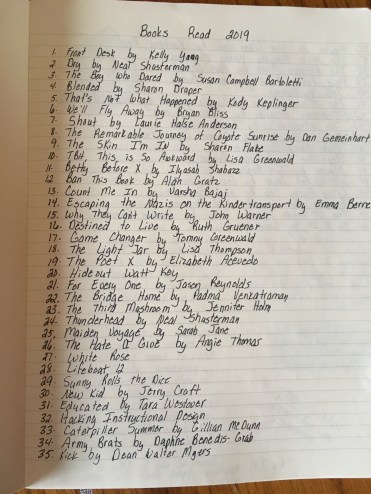
At the beginning of each year, I start a “books read” list. Although I have a Goodreads account, I like having easy access to a list of books I have read.

ttt6

I also play with words and do some initial drafting and explore for potential blog posts.

But here’s the thing…I am not consistent. These pages are actually weeks and sometimes months apart. This is why I have accepted Michelle’s #100daysofnotebooking challenge. I believe that teachers who write make better writing teachers and keeping a writer’s notebook is an important part of that development.

For more notebook inspiration, follow the #100DaysofNotebooking on Twitter or check out the Facebook group. You may also want to take a peek inside Shana’s notebook here and here or see how Amy reflected on an entry in her notebooks here. Seeing notebook pages from other writers always gives me new ideas and loads of inspiration.

If you want to create a better notebook writing habit, why don’t you consider joining me in the challenge? It is not too late to start, and you can find all of the information on Michelle’s website.

Happy New Year and Happy Notebooking!

Leigh Anne teaches 6th grade ELA in southern Indiana, is a notebooker-wannabe, and is ready to commit to a daily notebook habit.

Dinner Table Book Talks

“Never underestimate the power of a great book in the hands of a teacher who knows how to use it.”

This quote from Seven L. Layne in Igniting a Passion for Reading is one in which I often quote. I believe books have power and we, as teachers, have a great responsibility to transfer reading energy by what we do with them. But many times, our students hold that power too.

Many teachers give book talks in their classrooms, which are a fun way to get kids reading and buzzing about books. I have found that when teachers create a short presentation about a book they have read, students are more apt to pick that book up and read it themselves.

I like to eventually give students the opportunity to give book talks to their peers, but before I hand this responsibility off to them, preparation and teaching need to be done.

In the book, In the Middle by Nancie Atwell, she talks about a time she and her husband sat around the dining room table with some friends and “gossiped by candlelight” about a book.  She compares her dining room table to a literate environment where people around it talk about literacy.  She states “We don’t need assignments, lesson plans, lists, teacher’s manual, or handbooks.  We need only another literate person.”

After reading this, I began to wonder how I could bring that dining room table environment to my own classroom? How could I use the low-risk environment of sitting around a dinner table to encourage my kids to have these discussions about books?

Enter dinner table book talks.

plate 6

Students are given a paper plate (non-coated works best). Some years I have given them no instructions but to think about a book they have loved this year and create a prop to help them talk about the book. Other times, I have given them specific requirements such as title, author, passage, summary, or a blurb. No matter what the directions were, they have enjoyed being creative with their plates.

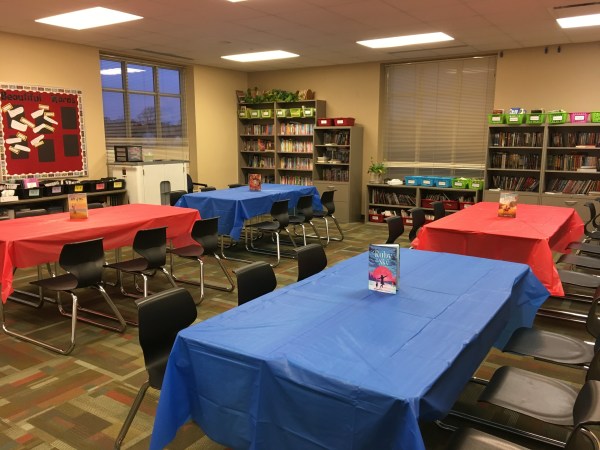
I tell them they will be doing book talks, but I do not tell them what this will entail. The room is set up like tables with tablecloths and some type of centerpiece. They take their plates and find a seat at a table. Each student uses their plate to help them give their first talk. After some time has passed, they get up and mingle, find a new table, and give another talk. We continue to mingle until they have given 3-4 talks.

These first book talks are unpolished and imperfect, but they get the conversations going in a low-risk environment of sitting around the dinner table with their friends. This space becomes a place where they can share the books they have read without the anxiety of talking in front of the whole class.

This activity is the perfect way to add a little “art” to English language arts, boost student confidence, and hand over the power to students while placing book talks at the head of the table!

Leigh Anne teaches 6th grade ELA in southern Indiana and gave this perfect-for-a-sub assignment while she attended NCTE in Baltimore.

A New Look at Data

Data seems to be one of those educational buzz words that has been swinging on the pendulum just like many other educational topics.

When I first began teaching 12 years ago, we had data walls, data folders, data charts, and data talks. In those early years, I taught 4th-grade departmental math. It was easy to collect and analyze data and use that data to inform my instruction. It was easy to assess whether a student knew how to multiply two-digit numbers or find the area of a rectangle. And it was easy to use that instruction to plan additional days of reteaching the entire class or planning small group instruction for the few students who had not quite mastered the skill.

As an English language arts teacher, I found data much more difficult to collect. Data is necessary, but for many, it has become a dreaded four-letter word. Language arts standards, like my Indiana standard below, are so packed with skills, collecting data can be time-consuming, overwhelming, and many times irrelevant.

Standard TTT

For the past several years improving data collection has been a personal goal for me because I knew this was a weakness. I wanted data that was relevant, easy to collect, and could be used to make instructional decisions. I wanted to be able to show my administrator who was making progress, who was not, and what I was doing about it. But that goal has not been an easy one to reach.

It wasn’t until this past summer when I attended a workshop with Kate Roberts, that the data light bulb came on. Her presentation made so much sense, and I left wondering why I hadn’t used this approach to collecting data before now?

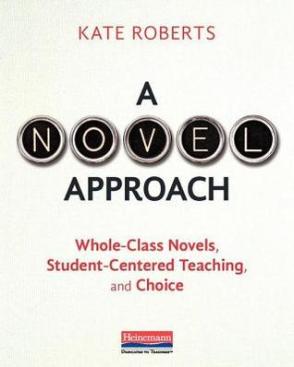
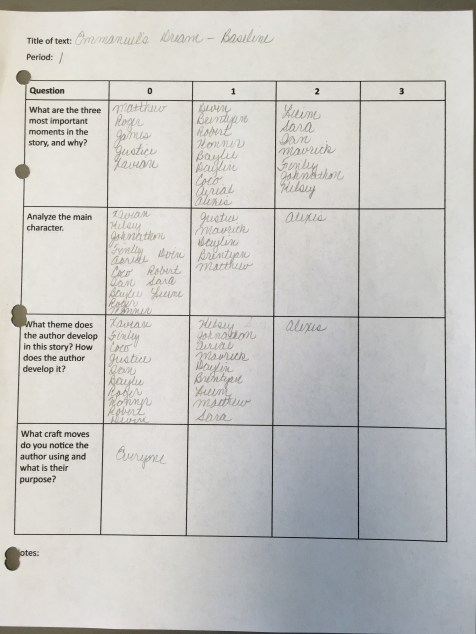
In Kate’s book about using whole-class novels, A Novel Approach, she advises teach37946464._SX318_ers to give students a reading assessment before diving into the unit to identify skills that need to be taught or improved upon during the unit. I gave a similar assessment at the beginning of the year as a baseline based on these questions from Kate’s book:

  1. What are the three most important moments in this story, and why?
  2. Analyze the main character.
  3. What theme does the author develop in this story?
  4. What craft moves do you notice the author using and what is their purpose?

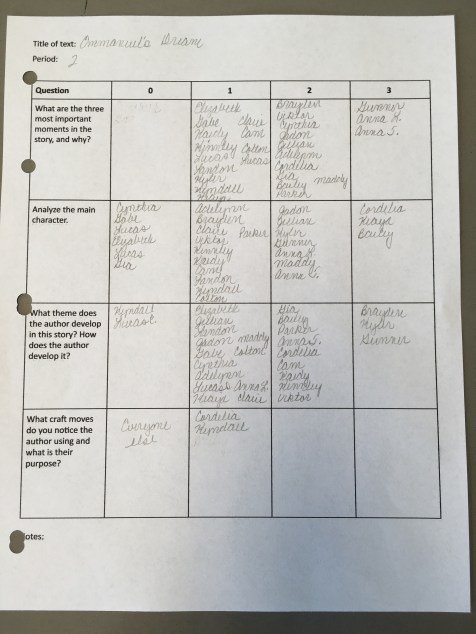
After scoring the assessment, I completed a grid shown below. This quickly gave me a snapshot of the skill level of each class and let me know which students needed additional instruction or who could benefit from small group instruction. Kate scores them 1-3, but I changed it to 0-3, as I had many students who did not know how to do some of the skills. As you can see from the grid, my students did not know the term “writer’s craft,” and that skill will now become more of a focus in my instruction.

When analyzing characters, most students were able to give me a trait, but could not support that claim. Interpreting theme had similar results. They could give me a theme but had no idea of how it was developed through the story.

pres. 1

pres 2

After giving the baseline, I told my students these four skills needed to be mastered by the end of the year. That doesn’t mean I won’t teach other skills; these are just the ones that I will assess and track throughout the year.

Students will work on these skills throughout the entire school year. I have a spreadsheet where I track each student’s progress, and they have one where they track their individual progress.

Reading Skills Assessment

I like this assessment for data collection for many reasons:

  • Simplicity – This assessment is quick and easy to administer, as it can be done in one class period. Scoring is easy when you sort student responses according to patterns that you see. Kate compares it to dealing out a deck of cards, each pile being beginning, intermediate, and advanced. These piles become a starting point and eventual guide for instruction.
  • Versatility – Students need to be able to demonstrate what they can do with these skills, so matching them to a text they can read independently is important. The four questions work well with almost any fiction text. I used the baseline with a read-aloud, thus making the text accessible to all students. I have also used the assessment with their independent books, and I plan to use it with their book club selections by the end of the semester.
  • Relevancy – Each Common Core Standard is packed with skills. The four questions in the assessment are general, yet can measure the standards as they are unpacked. The skills assessed are what we notice and do automatically as adult readers, so teaching students these skills is showing them the relevancy of learning them.

I don’t think data has quite the educational buzz that it used to, and I still think collecting reading and writing data is difficult. But after working with Kate and looking at data in a new way this year, I now know that data doesn’t have to be a dreaded four-letter word anymore.

Leigh Anne Eck is a 6th grade ELA teacher in southern Indiana and is anxiously awaiting the learning to be done at NCTE in Baltimore. She hopes to meet many of her online friends in person.

Being Changed

baby-changing-chest-of-drawers-4518766_1920Before I became a teacher, I was a district manager for a women’s retail chain. One year the company went through a major change in their customer service program that included hours of new training. Our management team was under enormous pressure to perform, and no one was happy about the change. Marilou, our human resource manager, told us, “The only people who like to be changed are babies.” That quote has stuck with me all these years.

As a teacher, I have gone through so many changes. From grade levels to buildings and administrators to teaching partners and new standards to new testing and to the next how-to-get-higher-test-scores program. These changes add additional stress to already stressed-out teachers.

Change is simply a part of education; however, being changed is more accepted by reflective teachers. As I look back at the changes I have made in my classroom, implementing reading and writing workshop has been my most challenging, yet also the most rewarding.

In the early stages of this journey, I read books and blogs and attended conference sessions on reading and writing workshop. I met educators on social media who have been using workshop successfully for years. They made it appear so easy. In their perfect (in my mind) classrooms, independent reading was at the forefront, writing mini-lessons moved seamlessly into work time, and conferring with students was productive. I thought this was how teaching was supposed to look and was how I wanted my classroom to be.

I started my teaching career as an elementary “basal teacher” because that was what I knew and was how the other teachers taught. Prompt writing was our curriculum because that was how writing was tested. After moving to middle school and becoming a mentor teacher, I knew this would be the perfect time to make a change toward the workshop approach.

Independent reading has been the heartbeat of my classroom for many years and was already in place. Once I made the commitment to try the workshop approach, my mini-lessons became focused on the skills and strategies my students needed to become successful readers and writers. Conferring became routine, and reading and writing became engaging and authentic for my students. None of these changes happened overnight, and I am still changing.

If you have decided to make the change to workshop, then I encourage you to think about these three ideas to get you started:

  • Think Big–Start Small  When deciding to implement reading and writing workshop, see the big picture. Have a goal of where you want to be but begin with little steps to get there. Implement small pieces of the workshop model. I began with choice–giving students choice in the topics to write about and the books to read. I slowly began creating mini-units that included a series of mini-lessons with work time and conferences built in. You could begin here, or you might begin with collecting mentor texts or focusing on making your mini-lessons “mini.” The important part is that you take that first small step.
  • Allow Failure and Accept Grace  Many days I wanted to quit and go back to what was easy. I wanted my workshop to look, sound, and feel perfect. Most days it wasn’t. But then I realized I needed to give myself some grace because change takes time. My students were beginning to see the connection between reading and writing and that the work was authentic. It was what real readers and writers do. I knew I was going in the right direction.
  • Make Connections  I come from a district that does not use workshop, so any learning has always been on my own. Making connections with mentors made it easier. Three resources that I read at the beginning of my journey were Donalyn Miller’s The Book Whisperer and Book Love and Write Beside Them by Penny KittleThese three books gave me the courage to do what I knew in my teacher’s heart was right, and I never turned back.

The Three Teachers Talk blog has a wealth of resources on implementing reading and writing workshop. Penny and Donalyn were the “big picture” and Three Teachers Talk has been the “small steps” I needed for my own professional development. 

My journey is far from over as I continue to learn, reflect, and change every day. I am no expert, but I share with you what I have learned in hopes to make your journey to workshop teaching a little bit easier.

I think I may need to revise Marilou’s quote to: “The only people who like to be changed are babies and reflective teachers.”

Change is hard; being changed is amazing.

As teachers, we are all on a journey, but we don’t have to go it alone. Please share your journey with us in the comments section.

Leigh Anne Eck teaches 6th grade English language arts in Southern Indiana and loves to learn. She recently recieved her Master’s degree in Curriculum and Instruction at the young age of 55. She loves partnering with her husband in parenting their young adult children. Connect with Leigh Anne on Twitter @teachr4.